

Your best nurse burns out because they’re repeatedly asked to stay late, pick up extra shifts, cover call-outs, and absorb pressure your other team members don’t. Over time, dependability can turn into extra work, and extra work can turn into turnover risk overnight.
Your best nurses are easy to rely on.
They answer your texts, pick up on the weekend, and stay late when the schedule falls apart. That kind of reliability is extremely valuable to your leadership team. But it’s also risky.
In most facilities, the most dependable employees quickly become the backup staffing plan.
It’s not intentional, but after repeated reliance, turnover risk starts.
Burnout and turnover are closely linked in nursing research, with emotional exhaustion playing a central role in whether nurses start thinking about finding a new job or leaving healthcare altogether.
The hard truth: Your best staff might not be the safest staff to keep asking. They may be the closest to done.
The Reliable Employee Tax
The “Reliable employee tax” is what happens when dependable staff get rewarded with more pressure.
They say yes once, so they are the new default ask. Then it happens again and again until it’s eventually expected.
Your leadership team sees this as great teamwork. But your employees see it differently. They’ll start to feel like:
- “I’m always the one they call.”
- “If I say no, the shift falls apart.”
- “Other people get protected, but I get asked.”
- “My reliability is being used against me.”

That is when loyalty starts to feel expensive.
Good employees usually want to help. But they also notice when helping becomes the expectation instead of the exception.
Why Good Nurses Don’t Always Complain First
High-value nurses don’t always announce they are burned out. Many pull back quietly. They stop volunteering; they quickly stop answering; they stop picking up extra; they stop offering solutions; they do the job, but the extra effort disappears. It’s not them being lazy; they’re protecting themselves.
A nurse who used to say yes every time may start saying, “I can’t.”
A CNA who used to cover weekends may stop checking the schedule.
A reliable employee who used to help managers solve problems may become quiet.
By the time they openly complain, the decision to leave may already be forming.
Recent nursing research continues to connect burnout, stress, job satisfaction, and turnover intention, which reinforces that retention risk builds before someone actually resigns.
Warning Signs Your Best Staff Are Near Their Limit
The warning signs are usually subtle. Watch for changes in behavior, not just complaints.
Reduced availability
A strong nurse who used to pick up shifts suddenly becomes unavailable. Not just once, but constantly. That may mean that they are protecting their recovery time because the workload has become too much.
It’s no secret that healthcare is an extremely demanding job.
Your team, and especially your nursing staff, need time to recover between shifts so they can come to work with a clear mind.
Shorter responses
Coverage texts that used to get quick replies now get short answers.
“Can’t.”
“No.”
“Unavailable.”
That shift in tone matters.
Not because the words themselves are rude, but because they signal a change in posture. Before, communications probably carried a sense of collaboration, even when your team was desperate.
Now, most responses feel transactional and compressed to the point of emotional flatness.
That usually happens when people are overloaded. They don’t have time or emotional energy to even pretend they care.
A scheduler managing dozens of holes across multiple units doesn’t have time for a carefully worded explanation. A nurse declining a fourth extra shift this week may not have the energy to soften the response.
The shorter the reply, the more it can reflect exhaustion, urgency, or detachment.
And over time, those tiny exchanges shape your facility’s culture.
A one-word response changes how supported people feel. It changes whether staff perceive flexibility as a partnership or as a constant negotiation. It changes whether someone volunteers for the next tough shift or silently disengages.
In healthcare staffing, tone is operational data.
You can usually detect burnout, distrust, or communication breakdown long before it appears in turnover reports or vacancy metrics. The clues show up first in the language.
The staffing gap isn’t just numerical at that point. It becomes relational.
And once communication shifts from cooperative to survival-mode efficiency, rebuilding trust becomes much harder than filling a single shift.
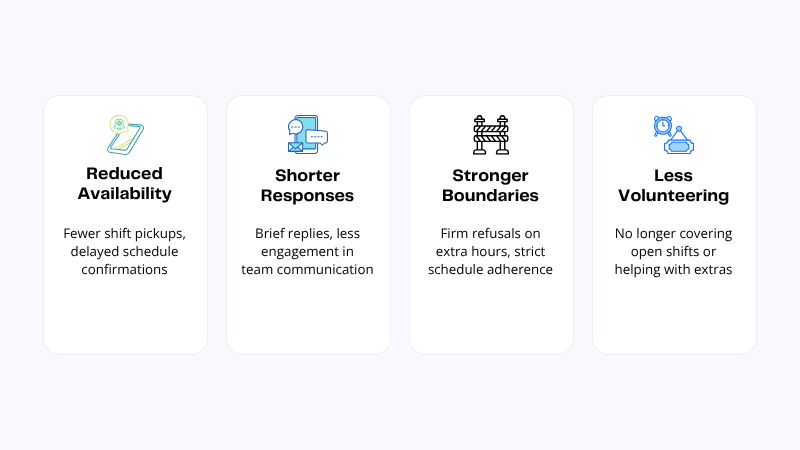
More boundaries
Boundaries are healthy.
But sudden, firm boundaries from someone who used to overextend can signal that they are correcting a pattern your facility should have noticed sooner.
When the person who always said “Yes” starts saying “I can’t anymore,” it’s easy to label it as a change in attitude.
But it’s more likely to be a delayed correction.
People don’t usually go from flexible to firm overnight without a reason. They get there after too many missed breaks, too many last-minute asks, too many “just this once” shifts that became the norm.
A boundary isn’t the problem. The problem is when a facility’s staffing model quietly depends on certain people not having boundaries.
That’s where you and your team need to pay attention. Sudden boundaries are often a signal that goodwill has been spent. The nurse is no longer negotiating for teamwork. They are protecting themselves from a pattern that became unsustainable.
And once staff start protecting themselves from the system, your facility has already lost more than coverage.
It’s lost trust.
Less volunteering
They still do their job. They still show up. They still meet the expectations in front of them. But the extras disappear. Gen Z and younger millennials make up most of the workforce’s “quiet quitters.”
The shift is easy to miss because performance still looks fine on paper. The scheduled shift gets worked. The required tasks are done. They’re still professional.
But what disappears is discretionary effort – the effort that goes beyond the bare minimum.
And in healthcare staffing, discretionary effort is usually what keeps the schedule from cracking.
When staff stop volunteering, they are usually not making a dramatic statement. They are recalculating. They are deciding that the extra effort they gave wasn’t noticed, protected, or balanced fairly enough to continue.
Comments like these are worth paying attention to:
“It’s always the same people.”
“Some people never get asked.”
“I’m tired of being the backup plan.”
That’s not just complaining.
That’s retention data.
Those comments reveal how your team is interpreting the system. They’re noticing who gets asked, who gets protected, who gets pressured, and who gets a pass.
Once people believe the workload isn’t being shared fairly, every coverage request lands differently. It stops feeling like teamwork and starts feeling like proof that the same people are carrying the strain.
Leaders should treat those comments as early warnings.
Why This Becomes a Turnover Problem
Turnover risk grows when strong employees feel the workload is unfair, unsustainable, or invisible.
They might still like their work.
They might still care about their residents or patients.
They may even like their manager.
But if they feel like your leadership team keeps leaning on them without changing the pattern, they’ll start looking for relief somewhere else.
That relief could look like:
- Reducing availability
- Moving to PRN elsewhere
- Leaving for another facility
- Switching shifts
- Leaving bedside care
- Taking a role with less chaos
Their departure might feel sudden. But that’s rarely the case. Most of the time, the signs were there, but no one was paying attention.
How to Protect High-Value Staff Before They Leave
Protecting your best staff doesn’t mean asking less from everyone. You need to build a fairer system before your strongest employees burn out.
Rotate coverage requests
Don’t always start with the same group of people.
Create a retention plan for extra shifts, call-outs, and last-minute coverage requests. Make sure you rotate through who you’re asking so you can keep things fair.
Track who gets asked, not just who says yes. That will keep you from asking the same people over and over.
Watch who carries the most extra work
Look beyond total overtime.
Ask:
- Who is covering the most call-outs?
- Who is picking up the hardest shifts?
- Who keeps staying late?
- Who is always asked first?
- Who has started saying no more often?
This shows where retention risk may be building.
Stop rewarding reliability with more pressure
Dependability should lead to trust, respect, and growth. After all, these are your best employees; it would be foolish to treat them like someone who’s easily replaceable.
If someone is constantly helping, acknowledge it – and then protect them from becoming the default solution.
Leaders also need to ask better questions.
Not just:
“Can you pick up?”
But:
“Are we asking you too often?”
“Which shifts are starting to feel unsustainable?”
“Where do you think coverage feels unfair?”
“What would help you keep your schedule manageable?”
Those questions change the conversation.
They move it from pressure to partnership. They show staff that leadership isn’t just trying to fill the next hole, but also trying to understand where the staffing model is wearing people down.
Because the answers will tell you more than a declined shift ever could.
They will show you where goodwill is thinning, where fairness is being questioned, and where reliable people are at risk of becoming resentful people.
Use PRN support before your core staff are overextended
Flexible PRN support can help reduce overtime pressure on high-value employees before they start pulling back.
Cascade Health Services connects facilities with pre-vetted W-2 nurses, CNAs, allied health professionals, and more through its W-2 Workforce Marketplace. Facilities can request staff, track shift status, manage schedules, view reporting, and maintain credential and compliance visibility, while Cascade handles HR, taxes, insurance, work comp, and related employer responsibilities.
The goal is not to replace your best staff.
The goal is to stop overusing them.
The Staff You Trust Most Still Need Protection
The most reliable people are often the easiest to overlook.
They do not always complain.
They do not always escalate.
They do not always say no.
Until they do.
And when they finally decide they are done, replacing them is not simple.
You lose their skill.
Their consistency.
Their relationships.
Their institutional knowledge.
Their stabilizing presence on the floor.
That is why nurse turnover risk should not only be measured by who is struggling visibly.
It should also be measured by who is quietly carrying too much.
Download the Facility Leader’s Burnout Toolkit
Your best employees should not become your emergency staffing plan.
The Facility Leader’s Burnout Toolkit helps healthcare leaders spot hidden staffing strain before it turns into turnover.
Inside, you’ll get:
- A burnout warning sign checklist
- A staffing pressure risk score
- Leadership-ready talking points
- Action steps to reduce burnout risk
Download the Burnout Toolkit to spot hidden turnover risk early. The toolkit is designed to help leaders identify staffing strain before burnout becomes a retention problem.
FAQs
Why are reliable nurses at risk for burnout?
Reliable nurses are at risk when they are repeatedly asked to cover extra shifts, stay late, or absorb staffing gaps because leaders know they will say yes.
What are the early signs a nurse may be close to leaving?
Early signs include reduced availability, less willingness to pick up shifts, shorter responses, frustration about fairness, disengagement, and stronger boundaries around extra work.
How can facilities reduce nurse turnover risk?
Facilities can reduce nurse turnover risk by tracking who carries extra work, rotating coverage requests fairly, reducing repeated overtime, listening to staff feedback, and building burnout-resistant staffing models before core staff are overextended.
Why don’t burned-out nurses always complain?
Many high-performing nurses try to manage the pressure quietly. They may pull back, stop volunteering, or disengage before they openly complain or resign.
