
How can facilities reduce nurse overtime?
You can reduce nurse overtime by identifying where overtime repeats, setting escalation thresholds, distributing coverage more fairly, and using flexible PRN staffing before overtime becomes the default backup plan.
Overtime isn’t always the problem.
Sometimes, overtime is necessary. Healthcare changes fast. Call-outs happen. Census shifts. Weekends get tight. People get sick.
The problem is when you rely on overtime as your main staffing strategy.
If overtime keeps showing up in the same units, on the same shifts, or with the same employees, that’s not a payroll issue. It’s a scheduling strategy issue.
And it can be fixed more strategically than telling managers to “watch labor.”
Step 1: Separate Occasional Overtime From Patterned Overtime
Not all overtime means the same thing. Occasional overtime is expected in healthcare.
Patterned overtime is different.
Patterned overtime means you are repeatedly using extra hours to solve the same coverage problem. These staffing gaps get expensive.
Look for:
- Overtime on the same days of the week
- Overtime in the same unit
- Overtime tied to the same role
- Overtime after predictable call-out patterns
- Overtime concentrated among the same employees
This is where you should focus first. Don’t start with total overtime. Just focus on repeated overtime. Once you have that figured out, it’s time to make a burnout-resistant staffing strategy.
Step 2: Build an Overtime Heat Map
A simple overtime heat map can show you where the pressure lives.
Track it by:
| Category | What to Look For |
| Shift type | Nights, weekends, holidays, last-minute gaps |
| Unit | Departments with repeat extra hours |
| Role | RN, LPN, CNA, CMA, allied roles |
| Employee | Staff carrying repeated overtime |
| Timing | Days or pay periods where overtime spikes |
| Cause | Call-outs, census, open shifts, and scheduling delays |

This turns overtime from a vague budget concern into an operational map you can act on.
Now you can ask better questions:
- Is this a weekend problem?
- Is this a unit problem?
- Is this a role problem?
- Is this a call-out problem?
- Is this an escalation problem?
- Are we asking the same people too often?
Step 3: Set Overtime Escalation Rules
Without clear thresholds, overtime decisions happen in the moment. You know how it feels to scramble to find last-minute coverage. Give your managers guidance on how to escalate. So the fastest solution isn’t the one that wins every time.
Set rules like:
- If one employee works extra twice in a pay period, review before asking again.
- If one unit exceeds a weekly overtime threshold, escalate to leadership.
- If the same shift type creates overtime for three weeks, build a coverage plan.
- If call-outs trigger overtime repeatedly, review call-out timing and staffing backup.
- If managers spend more than a set amount of time filling shifts, review outside support.
The goal isn’t to block every overtime shift. You just want to stop overtime from becoming the automatic solution.
Step 4: Stop Using the Same Staff as the First Call
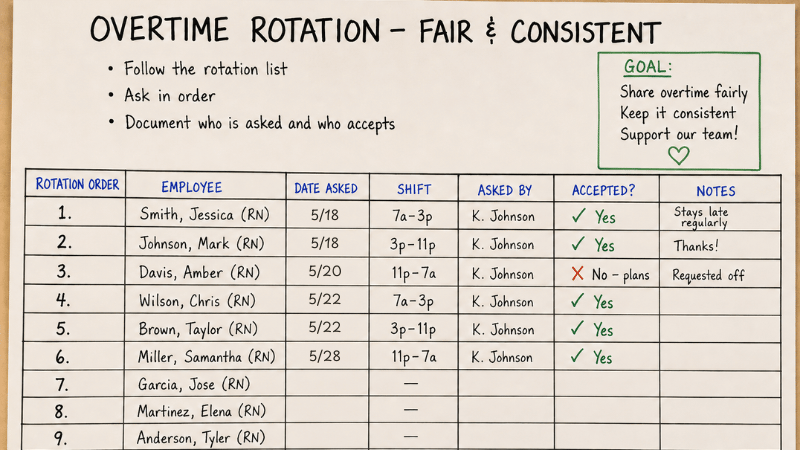
Every facility has people who always say yes. That doesn’t mean they should always be the first people you ask.
If the same nurse or CNAs are working the most overtime, reducing overtime becomes a retention strategy.
Create a fairer coverage process:
- Rotate pickup requests.
- Track who was asked.
- Track who accepted.
- Watch for repeat patterns.
- Pause before asking the same person again.
This keeps overtime from quietly concentrating on your most dependable staff. Being dependable shouldn’t come with a penalty.
Step 5: Fix the Timing Problem
A lot of overtime is created because coverage decisions happen too late.
By the time the shift is open and urgent, options are limited. That’s when managers start texting everyone.
Instead, review upcoming pressure points early:
- Weekend needs
- Holiday coverage
- Known PTO
- Repeat call-out patterns
- Census-sensitive periods
- Historically hard-to-fill shifts
If a gap is predictable, it shouldn’t be treated like a surprise.
Step 6: Use PRN Staffing for Repeat Pressure Points
PRN staffing works best when it is used before overtime becomes the only option.
Use flexible PRN coverage for:
- Weekend gaps
- Overnight shifts
- Holiday coverage
- Repeat call-outs
- Hard-to-fill roles
- Units with recurring overtime
PRN agencies aren’t built to replace your core team. They’re here to help protect them.
Cascade Health Services’ W-2 Workforce Marketplace gives facilities access to pre-vetted nurses, CNAs, allied health professionals, and more, with scheduling visibility, credential and compliance support, reporting, and 24/7 human support.
Step 7: Review Overtime Monthly
Reducing overtime isn’t a one-time fix.
Review it every month.
Track:
- Total overtime hours
- Overtime by unit
- Overtime by shift
- Overtime by employee
- Call-outs
- Internal pickup rates
- PRN usage
- Manager coverage time
Then ask:
Did overtime go down because staffing improved, or because teams are running short?
That distinction matters.
Reducing overtime only helps if coverage and patient care stay stable.
Download the Facility Leader’s Burnout Toolkit
Overtime is one of the first measurable signs that staffing pressure is building.
The Facility Leader’s Burnout Toolkit helps leaders connect overtime patterns to burnout risk before the issue turns into call-outs, morale problems, or turnover.
Inside, you’ll get:
- A burnout warning sign checklist
- A staffing pressure risk score
- Leadership-ready talking points
- Action steps to reduce burnout risk
Download the Facility Leader’s Burnout Toolkit to spot overtime-driven burnout risk before the schedule breaks.
FAQs
What is the best way to reduce nurse overtime?
The best way to reduce nurse overtime is to track where overtime repeats, set escalation thresholds, and add flexible coverage options before overtime becomes the default solution.
Is nurse overtime always bad?
No. Some overtime is expected. It becomes a problem when it is repeated, concentrated among the same staff, or required to keep the schedule functioning.
How does PRN staffing reduce overtime?
PRN staffing gives facilities flexible coverage for recurring gaps, call-outs, weekends, nights, and hard-to-fill shifts without relying only on full-time staff to work extra.
What should facilities track to reduce overtime?
Track overtime by unit, shift type, role, employee, call-outs, internal pickup rates, manager coverage time, and PRN usage.
