
The best nurse staffing solution for long-term care in 2026 is a flexible, compliance-ready model that helps you protect your core team, fill skilled nursing gaps quickly, and maintain reliable coverage for nights, weekends, call-offs, census swings, and hard-to-fill shifts.
For most LTC and skilled nursing facilities, that means combining a strong internal workforce with supplemental nurse staffing support from a provider that can prove reliability, credential readiness, attendance visibility, and real human support.
Long-term care staffing has never been a “set it and forget it” problem; census changes, call-offs happen, weekend coverage gets tight, and experienced nurses burn out. When you’re running a skilled nursing facility, rehab center, assisted living community, or post-acute operation, every open shift creates pressure on residents, staff, leadership, and compliance.
So the question is not whether you need a staffing plan.
You do.
The real question is: which staffing model gives you the best coverage without creating more risk, more admin work, or more chaos?
Let’s talk about it.
What are nurse staffing solutions for long-term care?
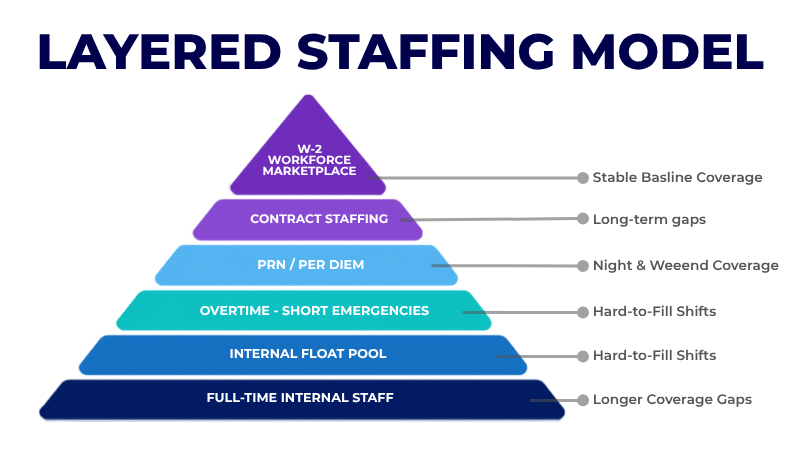
Nurse staffing solutions for long-term care are workforce models that help facilities cover open shifts beyond their permanent full-time team. They may include full-time hiring, internal float pools, overtime, PRN staffing, contract staffing, or a W-2 workforce marketplace.
In short, they help you keep the floor covered when your usual staffing plan isn’t enough.
Long-term care facilities use staffing solutions to cover:
- Skilled nursing staffing gaps
- CNA, LPN, and RN shortages
- Night shift openings
- Weekend coverage
- Call-offs
- Vacation requests
- Census spikes
- Seasonal demand
- Short-term contract needs
- Hard-to-fill recurring shifts
The best model is not always the cheapest one on paper. It’s the one that helps you maintain safe, consistent coverage without burning out your team or taking on unnecessary compliance risk.
Why is long-term care staffing harder in 2026?
Long-Term care staffing is harder because facilities are dealing with pressure from all angles: workforce shortages, higher acuity residents, unpredictable census, weekend staffing gaps, and increased scrutiny around staffing plans and documentation.
That means leaders need more than “someone who can send a nurse.”
You need a staffing strategy that answers practical questions like:
- Who can cover this shift tonight?
- Are their credentials current?
- Will they actually show up?
- Can we see attendance and shift status in real time?
- Who handles HR issues if something goes wrong?
- Can we scale up without over-hiring?
- Can we scale down without punishing our core staff?
That last one matters. Over-hiring creates cost pressure when census drops. Under-hiring creates overtime, burnout, and resident care risk when demand rises.
A strong long-term care staffing plan gives you room to flex without losing control.
What staffing models can long-term care facilities use?
Long-term care facilities usually need a mix of staffing models. No single option solves every coverage problem.
| Staffing model | Best for | Watch-out |
| Full-time hiring | Stable baseline coverage | Slow hiring process and fixed labor cost |
| Overtime | Short emergency gaps | Burnout and higher labor expense |
| Internal float pool | Multi-unit flexibility | Requires training, scheduling, and management |
| PRN/per diem staffing | Call-offs, census spikes, weekend gaps | Provider quality and reliability vary |
| Contract staffing | Longer coverage needs or guaranteed shifts | Less flexible than PRN coverage |
| W-2 staffing marketplace | Flexible coverage with stronger compliance support | Requires choosing the right provider |
The goal isn’t to replace your internal team. The goal is to protect them.
Your full-time staff should be the foundation. Supplemental nurse staffing should act as the pressure valve that keeps your facility from relying too heavily on overtime, last-minute scrambling, or the same dependable employees saying “yes” until they burn out.
How do you improve the reliability of nurse staffing?
You improve the reliability of nurse staffing by measuring more than fill rate. Fill rate matters, but it doesn’t tell the full story. A shift isn’t truly “filled” if the worker cancels late, shows up unprepared, lacks the right credentials, or requires extra admin work from your team.
Here’s what you should be tracking:
| Metric | Why it matters |
| Fill rate | Shows whether open shifts are being accepted |
| Attendance rate | Shows whether staff actually show up |
| Late cancellation rate | Reveals last-minute coverage risk |
| Credential readiness | Helps protect compliance and survey readiness |
| Repeat worker rate | Improves familiarity with your residents and workflows |
| Night/weekend coverage | Shows whether the provider can cover your hardest shifts |
| Response time | Measures how fast you can get help when staffing changes |

This is where provider selection matters the most.
A nurse staffing partner shouldn’t just send names. They should give your team visibility, support, and accountability.
Cascade Health Services, for example, pairs a W-2 workforce model with real-time credential visibility, GPS-verified clock-in/out, PBJ reporting, and 24/7 human support for facilities.
That kind of structure matters when you’re not just filling a shift. You’re protecting the operation.
How should LTC leaders cover night and weekend shifts?
LTC leaders should treat night and weekend shift coverage as its own staffing strategy, not as an afterthought. These shifts are usually harder to fill, more vulnerable to call-offs, and more stressful for the staff who consistently pick them up.
A better approach is to identify your high-risk shifts before they become emergencies.
Start by asking:
- Which weekend shifts go unfilled most often?
- Which units have the most call-offs?
- Which nurses are carrying too much overtime?
- Which roles are hardest to replace at the last minute?
- Which shifts need recurring PRN support?
Once you know the pattern, build coverage around it.
For example, if Sunday nights are consistently a problem, don’t wait until Sunday afternoon to look for help. Pre-book supplemental PRN staff, build a small internal PRN bench, or work with a staffing provider that can help you plan recurring coverage.
This is where flexible workforce planning pays off. You are not guessing. You’re using actual staffing patterns to prevent the same problem from happening every week.
How do you evaluate nurse staffing providers?
You evaluate nurse staffing providers by looking at classification, credentialing, attendance, visibility, support, compliance responsibility, reporting, and real-world coverage reliability.
Here’s an easy scorecard:
| Evaluation area | What to ask |
| Worker classification | Are clinicians W-2 employees or 1099 contractors? |
| Vetting | How do you screen and approve workers? |
| Credentialing | Can we see credentials before the shift? |
| Compliance | Who handles taxes, insurance, HR, work comp, and liability? |
| Attendance | Is clock-in/out verified? |
| Support | Can we reach a real person 24/7? |
| Reporting | Can we access PBJ or shift reports? |
| Coverage | Can you reliably cover nights, weekends, and call-offs? |
| Communication | How do we know shift status in real time? |
Don’t stop at “Do you have nurses?”
Ask how the provider protects your facility when staffing gets messy.
That includes cancellations, expired credentials, attendance issues, performance concerns, payroll questions, and documentation needs. The more of that burden your internal team has to manage, the less helpful the staffing solution becomes.
Cascade’s W-2 Workforce Marketplace is built around that facility-first model. Cascade handles compliance, taxes, HR issues, insurance, work comp, credential tracking, and live support. So facilities can get qualified clinicians without taking on the management headaches that come with staffing.
What should a 2026 long-term care staffing plan include?
A strong 2026 LTC staffing plan should include core staffing, flexible supplemental coverage, a night and weekend strategy, a call-off response plan, compliance visibility, and measurable staffing goals.
At a minimum, your plan should define:
- Your baseline staffing needs
Start with what your facility needs when your census is stable and operations are normal. This is your core team plan.
- Your flexible coverage triggers
Decide when to use supplemental nurse staffing. Triggers might include census increases, call-offs, open weekend shifts, PRO clusters, staff leave, or overtime thresholds.
- Your night and weekend plan
Hard-to-fill shifts need proactive planning. Identify recurring gaps and build coverage before the schedule breaks.
- Your call-off response process
Know who gets contacted, when supplemental staffing is activated, and how leadership is notified.
- Your compliance requirements
Make sure credentials, licenses, attendance records, and documentation are visible and organized.
- Your success metrics
Track fill rate, attendance, overtime, agency spend, staff burnout signals, and resident care continuity.
The best staffing plans aren’t complicated; they’re clear, measurable, and easy to activate when things change.
When should you use supplemental nurse staffing?
You should use supplemental nurse staffing when your internal team cannot reliably cover demand without overtime, burnout, missed shifts, or constant schedule disruption.
Common signs it’s time for supplemental staffing:
- Open shifts are appearing every week
- Weekend coverage depends on the same few people
- Overtime is climbing
- Staff are showing signs of burnout
- Call-offs are creating last-minute panic
- Census changes are hard to manage
- Full-time hiring is moving too slowly
- Leadership is spending too much time chasing coverage
Supplemental staffing works best when it is used strategically, not only in crisis mode.
Instead of waiting until the schedule falls apart, use PRN or per diem staffing to support known pressure points. That might mean weekend coverage, seasonal census changes, high-turnover units, or short-term gaps while you hire permanent staff.
Are W-2 staffing providers better than 1099 staffing apps?
For most long-term care facilities, a W-2 staffing provider can reduce risk compared to a 1099 staffing app because the agency takes on employer responsibilities like HR, insurance, benefits, compliance, and workers’ compensation.
That does not mean every W-2 provider is automatically better. You still need to evaluate quality, responsiveness, credentialing, support, and reliability.
But worker classification matters a lot.
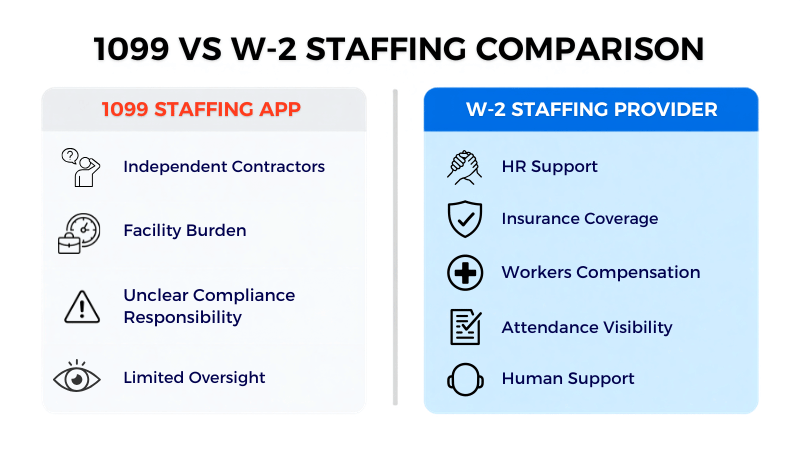
With a W-2 workforce partner, clinicians are employees, not independent contractors. That can create more structure, more accountability, and fewer surprises for facilities that need staffing support without taking on extra administrative burden.
Cascade’s model is an alternative to 1099 gig apps. Every clinician is a W-2 employee, and Cascade assumes employer burden while giving facilities access to vetted healthcare professionals through a staffing platform that’s backed by real human support.
How can Cascade Health Services help long-term care facilities?
Cascade Health Services helps long-term care and skilled nursing facilities fill staffing gaps with a W-2 workforce marketplace built for fast, flexible, compliance-conscious coverage.
Facilities can use Cascade to support:
- PRN nurse staffing
- Skilled nursing staffing
- CNA, LPN, RN, and allied health coverage
- Night and weekend shift coverage
- Last-minute call-offs
- Census swings
- Contract staffing needs
- Multi-facility workforce planning
Cascade combines technology with real support. Facilities can request staff, monitor shift status, manage schedules, view reports, access credential information, and get help from real people when staffing changes fast.
That matters because long-term care staffing is not just a software problem.
It is a people problem, a compliance problem, an operations problem, and a leadership problem.
The right staffing partner should help you move faster without making your team carry more work behind the scenes.
What is the best nurse staffing solution for long-term care?
The best nurse staffing solution for long-term care is the one that gives your facility reliable coverage, credentialed workers, flexible scheduling, compliance support, and clear visibility into shift status and performance.
For most facilities, the strongest approach is a blended model:
- Build your core schedule around your internal team.
- Use PRN/per diem staffing for flexible coverage.
- Use contract staffing for longer gaps or guaranteed needs.
- Track reliability by shift type, not just overall fill rate.
- Choose providers that reduce admin burden instead of adding to it.
In 2026, staffing success will come down to readiness.
Not panic.
Not endless overtime.
Not hoping someone picks up the shift.
A better plan gives your facility options before the schedule breaks.
FAQs about nurse staffing solutions for long-term care
What is supplemental nurse staffing?
Supplemental nurse staffing is the use of outside clinical staff to support your internal team when you have open shifts, call-offs, census changes, or hard-to-fill coverage needs. It can include PRN, per diem, local contract, travel, or workforce marketplace staffing.
What is skilled nursing staffing?
Skilled nursing staffing refers to the nurses, CNAs, and clinical workers needed to support residents in skilled nursing facilities. This may include RNs, LPNs, CNAs, medication aides, and other healthcare professionals, depending on the facility’s care model and state requirements.
How do LTC facilities cover night and weekend shifts?
LTC facilities cover night and weekend shifts by identifying recurring gaps, pre-booking coverage, using internal float pools, offering incentives, and partnering with supplemental nurse staffing providers that can reliably fill hard-to-cover shifts.
How do you measure the reliability of nurse staffing?
Measure staffing reliability by tracking fill rate, attendance rate, late cancellations, credential readiness, response time, repeat worker consistency, and performance on high-risk shifts like nights, weekends, and holidays.
What should I ask before choosing a nurse staffing provider?
Ask whether workers are W-2 or 1099, how credentials are verified, whether attendance is GPS-confirmed, who handles HR and compliance issues, whether support is available 24/7, and how the provider reports shift status and staffing performance.
Ready to make long-term care staffing less chaotic?
Cascade Health Services helps long-term care and skilled nursing facilities cover PRN, contract, night, weekend, and last-minute shifts with a W-2 workforce backed by real human support.
Start with the shifts that create the most stress. Build a smarter coverage plan around them. Then scale what works.
