
A flexible healthcare staffing strategy combines core employees, PRN support, clear escalation rules, and regular staffing reviews to cover changing demand without overusing staff or relying on last-minute scrambling.
Healthcare staffing isn’t still. Your census swings, people call out, PTO stacks up, weekends get tight, hard-to-fill roles stay open, and seasonal demands shift.
If your staffing plan is static, it won’t keep up with that much movement. That’s exactly why you need flexibility built directly into your staffing strategy before the schedule breaks.
Not as a panic button, and as much as I’d love to recommend it, you can’t write a blank check and hope everything works out. You have to build a real, reliable strategy, so you don’t burn out your core staff or your budget.
Why Static Staffing Plans Break
Static staffing plans usually assume the schedule will behave.
It won’t. It never does.
A staffing plan that looks fine at the beginning of the month can fall apart quickly when multiple variables hit at once.
Census changes
Patient or resident volume doesn’t always match the schedule.
When your census rises, your team feels like they need coverage fast. When your census drops, leaders may need to adjust without creating instability for staff.
A flexible strategy gives facilities a way to respond without overcommitting or under-covering.
Call-outs
Call-outs aren’t rare events in healthcare. The problem isn’t tied to just one call-out.
The problem comes in when call-outs repeatedly turn into overtime, management scrambling, or short shifts because there isn’t a backup plan.
Burning out your core team from constantly being short-staffed will create more staffing challenges down the road, and by the time you’re losing staff to burnout, it’s too late for a pizza party.
PTO
PTO is predictable, but it still creates more pressure when it overlaps with weekends, holidays, or already hard-to-fill shifts.
A flexible strategy reviews PTO patterns early instead of waiting until coverage becomes urgent.
Hard-to-fill shifts
Let’s be honest. Some shifts suck, and those are the hardest ones for you to cover.
Here are some examples we hear from our facility partners frequently:
- Nights
- Weekends
- Holidays
- Last-minute openings
- Certain CNAs, LPNs, RNs, or allied roles
- Units with higher acuity
- Units with recurring turnover
If the same shift is hard to cover every month, it should not be treated like a surprise.
Seasonal demand
Healthcare demand can shift by season, region, holidays, weather, illness trends, and facility-specific patterns.
Having a flexible staffing model helps your team prepare for predictable pressure instead of reacting every time staffing needs change.
Define What Core Staff Should Cover
A flexible staffing strategy starts with core staff capacity.
Before adding PRN or agency support, your leaders need to understand what the internal team can realistically cover.
Not what they can survive, but what they can sustain.
Baseline demand
Core employees should cover the facility’s normal, predictable staffing needs.
That includes:
- Regular unit coverage
- Standard weekday staffing
- Known recurring care needs
- Stable census patterns
- Predictable shift requirements
If core staff can’t cover baseline demands without constant overtime, your staffing model needs review.
Predictable scheduling needs
Some needs are predictable even if they’re harder to cover.
For example:
- Weekends
- Holidays
- PTO periods
- Known high-demand days
- Recurring night shift gaps
Since you know these are coming, they need to be planned into the model instead of being handled as an emergency.
Protected capacity
Your core team can’t be scheduled so tightly that one call-out breaks the system.
Protected capacity means leaders leave room for the reality of healthcare.
That may include:
- Limiting repeated overtime
- Avoiding constant last-minute asks
- Watching who picks up most often
- Protecting recovery time
- Not relying on the same dependable employees every time
This matters because the strategy is built around spotting staffing strain before it turns into burnout or turnover. Turnover costs a lot of money, and one of the leading causes for nurse turnover is burnout. You’ll end up saving money in the long run by protecting your core team.
Define Where Flexible Support Fits
Flexible support should have a clear role. It shouldn’t replace workforce planning; it should be built to strengthen it.
Demand spikes
When census rises or acuity increases, flexible support can help facilities respond without immediately overloading core staff.
This is especially useful when the demand spike is temporary.
Recurring gaps
If the same gap keeps appearing, flexible support can help stabilize your schedule while your leadership team addresses the root cause.
Recurring gaps may include:
- Same shift type
- Same unit
- Same role
- Same day of the week
- Same call-out pattern
A recurring gap needs more than a recurring scramble.
Weekends
Weekend staffing can create fairness issues. If the same employees are repeatedly asked to pick up on weekends, morale can slip quickly.
Flexible support can help reduce pressure on your core staff and make weekend coverage more predictable.
Nights
Night shift coverage can be difficult to stabilize internally. It’s a lot harder to convince a day shift employee to skip out on sleep to cover a shift, and odds are you’re already short-staffed at night, so you can’t just ask someone else.
When nights repeatedly require overtime or last-minute calls, flexible support may prevent the schedule from leaning too hard on the same people.
Short-term coverage needs
Flexible support is also useful for temporary gaps, like:
- PTO overlap
- Leave coverage
- Sudden vacancies
- Short-term census changes
- Seasonal demand
- Temporary role shortages
The key is matching flexible support to a defined need.
Not vague “just in case” usage.
Set Escalation Rules Before Gaps Become Urgent

A flexible staffing strategy needs decision rules. Without rules, every gap becomes a judgment call under pressure. That’s when a lot of facilities default to overtime, last-minute texts, or running short.
Overtime thresholds
Set clear points where overtime triggers review.
Examples:
- One employee works overtime more than twice in a pay period
- One unit exceeds a weekly overtime threshold
- A shift type creates overtime for several weeks in a row
- Overtime rises month over month
- Overtime is concentrated among the same people
Thresholds create a pause before overtime becomes automatic. Automatic overtime gets expensive fast, so setting rules can keep overtime from being a reflex.
Open-shift timing
Define when open shifts escalate.
For example:
- If a shift is open 7 days out, notify the scheduler
- If it is open 72 hours out, review internal pickup
- If it is open 48 hours out, evaluate PRN/agency support
- If it is open 24 hours out, follow the urgent coverage protocol
This helps leaders avoid last-minute scrambling.
Call-out response
Call-outs need a playbook.
Define:
- Who gets notified first
- How long internal coverage is attempted
- When overtime is allowed
- When flexible support is approved
- Which roles or shifts get priority
- How the call-out is documented for trend review
You’ll never make call-outs disappear. The goal is to stop every call-out from creating chaos. Your management team will thank you.
Agency/PRN approval rules
Flexible support should be easy enough to use when needed and controlled enough to prevent overuse.
Define:
- Who can approve PRN or agency support
- Which shifts qualify
- Which roles qualify
- What internal options must be reviewed first
- What budget limits apply
- What data will be reviewed afterward
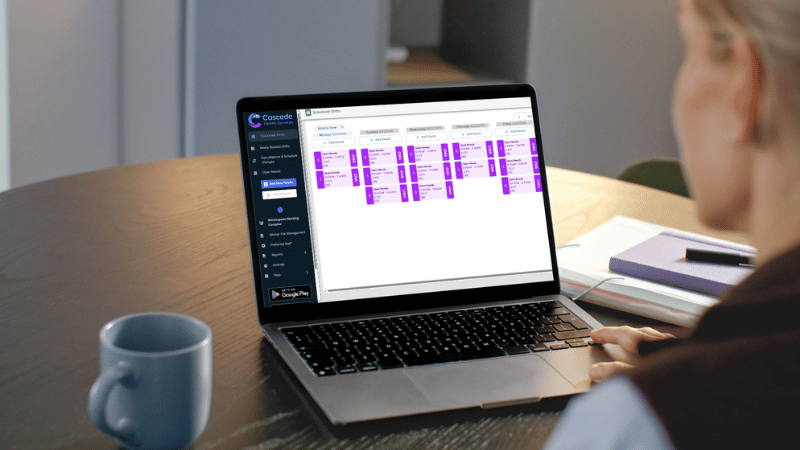
Cascade’s W-2 Workforce Marketplace gives facilities access to pre-vetted clinicians, scheduling visibility, credential/compliance support, reporting, and 24/7 human support, which can help leaders use flexible staffing with more control.
Review and Adjust Monthly
A flexible staffing strategy is not set-it-and-forget-it. It should be reviewed monthly so leaders can see what’s working, what’s drifting, and where pressure is building.
Fill rate
Fill rate tells leaders whether the schedule is actually stabilizing.
Track:
- Overall fill rate
- Fill rate by unit
- Fill rate by role
- Fill rate by shift type
- Fill rate for nights, weekends, and holidays
If your fill rate improves, the strategy is probably working.
If it stays flat while costs rise, your model needs adjustment.
Overtime
Overtime shows where your core staff is absorbing pressure.
Track:
- Total overtime
- Overtime by unit
- Overtime by employee
- Overtime by role
- Overtime tied to recurring gaps
You’ll never hit zero overtime. Your only goal is to control overtime and not let it become your staffing model.
Call-outs
Call-outs can show whether your staffing model is creating more strain.
Review:
- Call-outs after overtime-heavy stretches
- Call-outs by unit
- Call-outs by shift type
- Call-outs tied to recurring pressure points
A flexible model should reduce the cycle of overtime leading to fatigue, then fatigue leading to more gaps.
Turnover risk
Turnover risk often shows up before resignations.
Watch for:
- Declining pickup rates
- Reduced availability
- Frustration about fairness
- More staff are refusing extra shifts
- Higher overtime concentration
- Exit interview themes
- Manager concerns about morale
These are early signals that your staffing model may be overusing people.
Agency/PRN usage
Flexible support should be reviewed like any other staffing investment.
Track:
- Where PRN or agency support was used
- Why was it used
- What internal alternative was avoided
- Whether overtime decreased
- Whether the fill rate improved
- Whether staff pressure eased
- Whether the manager’s time decreased
Instead of asking “how much did we spend?” ask “Did flexible support make our staffing model more stable?” Agencies look more expensive than overtime on paper, but overtime actually costs you more than an agency when you take all of the factors into account.
A Simple Flexible Staffing Strategy Framework
Use this model to keep the strategy clear.
| Staffing Layer | Purpose | What to Watch |
| Core staff | Cover baseline demand | Are they being overused? |
| Internal PRN | Cover occasional flexible needs | Is pickup still strong? |
| External PRN/agency | Support recurring or hard-to-fill gaps | Is it reducing pressure? |
| Overtime | Handle short-term spikes | Is it repeated or concentrated? |
| Escalation rules | Prevent last-minute chaos | Are gaps addressed early? |
| Monthly review | Adjust the model | Are metrics improving? |
A flexible staffing strategy only works when every layer has a job. Core staff can’t carry everything, but agency support can’t be uncontrolled.
Overtime can’t be the default, but managers shouldn’t have to reinvent the process every week.
Download the Agency Staffing Decision Toolkit
Flexible staffing works best when leaders have clear decision rules.
The Agency Staffing Decision Toolkit helps facility leaders decide when outside support makes sense, how to set guardrails, and how to measure whether flexible staffing is actually improving coverage.
Inside, you’ll get:
- A decision score
- A cost comparison framework
- Agency-use guardrails
- Leadership-ready talking points
- A 30/60/90-day review structure
Download the Agency Staffing Decision Toolkit to build a flexible staffing strategy without losing control.
FAQs About Flexible Healthcare Staffing
What is a flexible healthcare staffing strategy?
A flexible healthcare staffing strategy combines core employees, internal PRN, outside PRN or agency support, overtime rules, escalation paths, and regular reviews to cover changing demand without overusing staff.
Why do healthcare staffing plans need flexibility?
Healthcare staffing plans need flexibility because census, call-outs, PTO, seasonal demand, and hard-to-fill shifts can change quickly. A static staffing plan often breaks down under real-world conditions.
How does PRN staffing fit into a flexible staffing strategy?
PRN staffing helps facilities cover as-needed shifts, recurring gaps, demand spikes, weekends, nights, holidays, and call-outs without relying only on full-time staff or overtime.
What should facilities review monthly?
Facilities should review fill rate, overtime, call-outs, turnover risk, staff pickup rates, manager coverage time, and PRN or agency usage.
How can facilities avoid overusing agency staffing?
Facilities can avoid overusing agency staffing by setting approval rules, limiting usage to defined pressure points, tracking outcomes, and reassessing support regularly.
