

Healthcare recruiting is constantly changing, but lately it’s taken a shift that has hit the industry hard. What worked five years ago doesn’t deliver the same results in a market that’s defined by massive workforce shortages, clinician burnout, and increasing demand for flexibility.
Hospitals, long-term care facilities, and rehab organizations are all competing for the same limited talent pool. To stay staffed, leaders have to rethink their recruiting strategies and adapt their models to reflect today’s reality.
Let’s break down healthcare recruiting strategies that actually work, why traditional approaches are failing, and how organizations can build sustainable recruitment systems without overhiring or overspending.
Cascade has been successful in recruiting clinicians for over 3 decades, and I’m going to lay out how we’ve built a strategy that can adapt to a changing environment and bring in more qualified candidates.
Table of Contents
Why Healthcare Recruiting Is So Challenging Right Now
Healthcare recruiting is challenging because of workforce shortages, burnout, wage competition, slow hiring processes, and rising demand for flexible schedules.
A lot of organizations struggle to compete with travel and PRN options, making traditional recruiting models less effective.
The challenges aren’t isolated; they’re compounding.
Key factors driving recruiting difficulty:
- National shortages of nurses and allied health professionals
- Increased retirements and early exits from bedside roles
- Wage inflation driven by travel nursing
- Long hiring workflows that lose candidates
- Census volatility that makes full-time hiring risky
Recruiting isn’t just about filling open spots. It’s about maintaining operational stability in an unpredictable environment.
The Biggest Healthcare Hiring Challenges Leaders Face
1. Time to Hire Is Too Slow
A lot of organizations still take 30-60 days to hire clinical staff. In today’s market, candidates are often off the market in a few days.
Cascade has seen a lot of success through streamlining workflows. That way, we can go from job posting to offering a position in the shortest amount of time possible. If you can’t onboard a new employee quickly, a 1099 staffing agency will get them onboarded as fast as the clinician can fill out paperwork.
2. Burnout Is Fueling Turnover
It’s obvious that staff turnover increases workloads, which drives burnout. Burnout eventually leads to even more vacancies. Recruiting without addressing workload balance can become a revolving door. Make sure your current staff feel supported, and they’ll stick around.
3. Overtime Spend Is Rising
When recruiting can’t keep up, organizations rely heavily on overtime to cover shifts, which increases labor costs and staff fatigue.
Using a healthcare staffing agency like Cascade can help fill vacancies without burning out your workforce. When used correctly, staffing agencies cost less than overtime, especially when nurses become burned out and find new jobs.
4. Census Fluctuation Complicates Hiring Decision
Hiring full-time staff during high census periods can backfire when patient volume drops. It’s normal to hesitate to hire, even when short-staffed.
This is where recruiting strategy directly overlaps with low census management, workforce planning, and flexible staffing models.
Core Healthcare Recruiting Strategies Every Organization Needs
There is no single solution to having the best healthcare recruiting strategy, but I’ll pull back the curtains on how Cascade has been successfully recruiting thousands of nurses.
Speed-to-Hire as a Competitive Advantage
Speed matters now more than ever. With 1099 agencies having the ability to onboard new nurses as fast as they can get paperwork and background checks submitted, healthcare organizations have to tighten up workflows to be as efficient as possible.
At Cascade, we recently overhauled our entire recruitment process to make it more streamlined. Since then, we’ve seen an uptick in important metrics:
- Offers were made faster, sometimes by days or even weeks.
- Reduced candidate drop-off.
- Paperwork is completed faster than we’ve ever seen.
All of this while continuing to only use W-2 staff.
Here are some things we took action on:
- Pre-screening questions: Adding in questions that are immediate disqualifiers. For example, we had a lot of applicants who didn’t even hold a license. We added a question asking, “Do you currently hold an active [position] license?” When someone answers “No,” they’re automatically disqualified, and our recruiting team doesn’t waste any time screening them.
- Simplified interview workflows: Instead of randomly calling people to schedule an interview and playing phone tag until we got an interview scheduled, we started sending out a list of open dates and times to candidates we were interested in. Now, our recruiting team spends all of its time recruiting candidates instead of scheduling interviews.
- Centralized decision-making authority: Sometimes, managers hold grudges against past employees for personal reasons unrelated to their work ethic. Centralizing who has a say in someone’s rehire status can help recruiters make more informed decisions on who they can bring back and who they can’t.
Flexible Staffing Models (PRN, Float Pools, Hybrid Approaches)

Super-rigid staffing models are one of the biggest barriers to effective recruiting.
Today’s clinicians value flexibility in their schedules, control over their workload, and opportunities to avoid burnout.
Flexible staffing strategies like internal PRN pools or external PRN agencies allow organizations to fill shifts without overhiring, reduce reliance on overtime, and quickly adjust staffing levels as census changes.
Flexibility isn’t just a perk anymore. It’s a recruitment requirement.
Improving your current staff’s satisfaction and retention is one of the most under-explored recruitment strategies. If your staff is happy, they’ll be more likely to recommend your organization to their friends.
Employer Branding in Healthcare Recruiting
Clinicians research employers before accepting a new role. They’ll look at online reviews to figure out who you really are as an employer.
Here’s what they’re looking at:
- Online reviews, especially in forums like Reddit.
- Word-of-mouth, if they don’t know someone who already works for you, or has in the past, they’ll once again turn to different online forums.
- Leadership Visibility: They want to know who the leaders are and what they stand for. LinkedIn is usually the first place they’ll start, but Glassdoor is another popular avenue to get to know managers.
Organizations with strong brands recruit more easily, even if they pay less than other organizations. Trust is incredibly valuable in the healthcare job market. Standing out in the right ways will attract more candidates.
Pay Transparency and Scheduling Flexibility
High pay isn’t all it takes to solve recruiting challenges, but a lack of transparency can stop it entirely.
Recruiting strategies should include:
- Clear pay ranges in job postings
- Honest discussions about workload expectations
- Flexible scheduling options when possible
When expectations align with reality, turnover drops, and recruiting becomes easier. Just remember, you can’t just talk the talk; nurses talk to each other about their organizations, and won’t hesitate to call you out if your job description doesn’t accurately reflect your organization.
Hospital vs. Long-Term Care Recruiting
Healthcare isn’t one size fits all, and your recruiting strategy shouldn’t be either. Hospitals experience high competition for specialized nurses, while LTC communities have a higher need for consistent coverage.
Hospitals
- High acuity and fast pace
- Strong competition for specialized nurses
- Greater reliance on PRN and float coverage
Long-Term Care & Rehab
- Chronic staffing shortages
- Higher turnover risk
- Greater need for consistent coverage
While strategies differ, flexibility and speed-to-hire are critical in both environments. If you don’t hire and get them working quickly, someone else will.
Nurse Recruiting Strategies vs Allied Health Recruiting
Not all clinicians are motivated by the same factors, and effective nurse recruiting strategies recognize these differences rather than applying a one-size-fits-all approach.
Nurse recruiting is heavily influenced by schedule control and workload sustainability. A lot of nurses are leaving their roles because of unpredictable schedules, frequent overtime, and understaffed units that contribute to burnout.
Recruiting efforts that highlight flexible scheduling, adequate support staffing, and a positive unit culture usually resonate strongly with candidates. Nurses want to know they won’t be consistently asked to “do more with less,” and organizations that can create realistic staffing ratios by utilizing PRN nurses will stand out as competitive.
Allied Health recruiting, on the other hand, is usually driven by a different set of priorities.
Allied health professionals typically place a higher value on predictable schedules, a clearly defined scope of practice, and opportunities for growth.
Transparency around job expectations, role boundaries, and advancement pathways plays an important role in attracting and retaining allied health professionals. Recruiting strategies that put emphasis on stability, career development, and respect for clinical specialization are more effective for allied roles than those that rely solely on flexibility or compensation incentives.
At the end of the day, healthcare organizations that tailor their recruiting strategies to the specific motivations of different clinical roles are more successful at attracting qualified candidates and reducing turnover. By aligning recruitment messaging, scheduling models, and staffing support with the needs of nurses and allied health professionals, leaders can build a more resilient workforce and avoid the pitfalls of generic recruiting approaches.
When to Use a Healthcare Staffing Agency
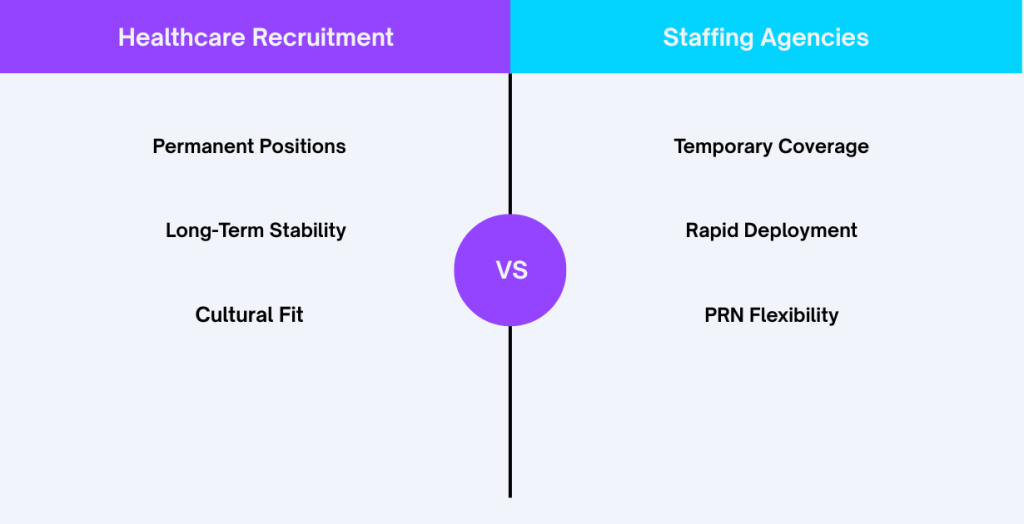
Internal recruiting teams are essential, but they have limits.
Healthcare staffing agencies can support recruiting efforts by:
- Reducing time-to-fill
- Providing coverage during seasonal spikes
- Scaling your workforce up or down depending on your census
- Preventing staff burnout
PRN staffing agencies offer flexibility without the long-term financial commitment of full-time hires or travel contracts.
The most successful organizations don’t choose between recruiting and staffing. They use both strategically.
Learn more about the differences between healthcare recruitment and staffing agencies
Building a Sustainable Healthcare Recruitment Strategy
Sustainable recruiting isn’t about filling today’s gaps; it’s about preventing tomorrow’s crisis.
High-performing organizations:
- Forecast staffing needs based on census trends
- Blend full-time, PRN, and float coverage
- Track time-to-hire and turnover metrics
- Continuously refine recruiting workflows
Recruitment becomes easier when the staffing strategy is proactive instead of reactive.
Healthcare recruiting has fundamentally changed.
The organizations that succeed:
- Move faster
- Offer flexibility
- Balance staffing models
- Protect their workforce from burnout
Recruiting strategies that worked in the past won’t carry healthcare organizations forward. Sustainable staffing requires modern thinking, flexible solutions, and realistic workforce planning.
Next read: How to Recruit Healthcare Professionals
