

You can control agency staffing costs by setting up usage thresholds, limiting agency support to high-pressure shifts, creating clear approval paths, reviewing usage monthly, and measuring outcomes against overtime, fill rate, call-outs, and manager time.
Agency staffing doesn’t have to be all-or-nothing.
The only wrong way to use agencies is using PRN agencies without rules, and avoiding agencies until the schedule breaks.
Neither of those options will help your overall staffing strategy.
Uncontrolled agency use can blow up the budget. But refusing agency support when staffing pressure is already building can create a different cost problem: overtime, call-outs, burnout, manager scramble, and turnover risk.
The goal isn’t “no agency.”
The goal is controlled agency.
That means every agency shift should have a reason, a threshold, an owner, and a review process.
Start With Agency Usage Rules
If agency staffing feels expensive or chaotic, the first fix is usually governance.
You need to have clear rules for:
- When your team can use agency.
- Who approves agency usage?
- What problems can the agency solve?
- How long can the agency be the solution?

Without rules, agency use becomes reactive. Someone calls out, the shift opens, and suddenly the schedule gets tight.
Leadership gets nervous.
Someone approves coverage under pressure.
That’s how costs creep.
Define when an agency can be used
Start by naming the situations where your team can use agency support.
Here are some examples to get you started:
- A shift has remained open past a defined deadline.
- Overtime has crossed a set threshold.
- Internal pickup is declining.
- A role is repeatedly hard to fill.
- Call-outs are rising in a specific unit.
- A manager has exhausted internal coverage options.
- A high-priority shift affects care continuity.
- The same staff is being repeatedly asked to cover.
The clearer the trigger, the easier it is for your team to function autonomously. Agencies shouldn’t be used because “we might need someone.” That’s just going to break your budget. Using them when specific staffing issues arise.
PRN agencies can be one of your best tools in combating nurse burnout. But, without a solid strategy, it’s just another cost.
Decide who approves agency usage
Approval should be clear before the schedule is under pressure. Decide which team members can approve outside agency help for each situation.
For example:
| Situation | Approval Owner |
| Same-day call-out | Scheduler or DON |
| Recurring weekend gap | DON + administrator |
| Overtime threshold exceeded | Administrator or operations leader |
| High-cost or extended agency use | Leadership review |
| Emergency coverage need | Pre-approved escalation path |
This will help you keep decisions consistent.
It also helps prevent agency use from becoming too easy or too hard. If your approvals are too loose, costs will rise. But on the other hand if they’re too slow, managers end up scrambling, using overtime, or running short.
Define what problem agency is solving
Every agency request should answer one question.
What are we trying to prevent?
Here are the most common things we hear from facility managers when they’re signing up for Cascade:
- Prevent overtime
- Prevent running short
- Prevent repeated use of the same staff
- Prevent managers from scrambling
- Protect coverage on hard-to-fill shifts
- Support a unit with rising call-outs
- Stabilize coverage during a short-term staffing disruption
This matters because agency usage needs to be measured against the problem it was meant to solve.
If agency was approved to reduce overtime, track overtime.
If the agency was approved to stabilize weekends, track weekend fill rate.
If agency was approved to protect internal staff, track repeated extra shifts, and pick up fatigue.
Prioritize the Right Shifts
Agency support should be targeted. Not every open shift deserves the same response.
The best way to control costs is to prioritize agency usage where internal coverage is most likely to create overtime, burnout risk, or operational instability.
Nights
Night shifts are usually harder to fill internally. If night coverage repeatedly requires overtime or last-minute pickup, having agency support might be a better pressure valve than asking the same staff to stretch.
Track:
- Night shift fill rate
- Overtime tied to nights
- Internal pickup rates
- Call-outs after night rotations
- Manager time spent filling nights
If nights are constantly creating a scramble, they should be on the priority list.
Weekends
Weekend gaps can create major morale issues.
Staff notice when weekend coverage is uneven. If the same people are asked to cover weekends every time an opening pops up, the issue becomes less about one shift and more about fairness.
Agency support can help protect internal staff from feeling like weekends always fall on them.
Prioritize agency for weekends when:
- Weekend gaps repeat
- Internal pickup drops
- Incentives are increasing
- The same employees keep covering
- Call-outs cluster around weekends
Holidays
Holiday staffing needs planning, not panic.
If facilities wait too long, holiday coverage often becomes expensive in more ways than one:
- Higher incentives
- More overtime
- More manager time
- More staff frustration
- Greater risk of last-minute gaps
Set holiday agency rules early.
Decide:
- Which roles are most vulnerable
- When internal pickup closes
- When agency support gets approved
- What incentives will or will not be used
- How coverage will be reviewed afterward
This prevents holiday staffing from becoming a budget surprise.
Hard-to-Fill Roles
Some roles are consistently harder to cover than others
That might include RNs, LPNs, CNAs, CMAs, allied roles, or specialty positions, depending on the facility.
If one role repeatedly creates overtime or open shifts, agency support should be evaluated as part of the coverage plan.
If your goal is to avoid agency entirely, you’ll always struggle with burnout and turnover. Instead, focus on finding the least disruptive way to cover roles reliably.
Last-Minute Call-Outs
Same-day call-outs are where agency decisions get messy.
The time pressure is real. That’s why call-out rules should be created before they happen. A strong call-out policy should define:
- How long have managers tried internal coverage
- When overtime is approved
- When agency can be requested
- Which roles or units get priority
- Who approves same-day agency
- How the shift is documented afterward
This gives managers a playbook instead of forcing them to improvise every time. Last-minute call-outs are worth tracking closely. Depending on your facility’s location, last-minute call-outs can be really hard to find coverage for. You’ll need to track these shifts closely, so you can decide what type of coverage provides the best continuity of care, while also protecting your core team as much as possible.
Avoid Blanket Agency Use
Agency cost gets out of control when usage becomes vague. If your team starts using the agency “just in case” or approvals start becoming automatic, that’s not controlled agency usage; that’s a major drift that can end up costing you more than you anticipated.
No automatic approvals
Automatic agency approvals can create dependency.
Every recurring agency request should still be reviewed against current staffing conditions.
Ask:
- Is this gap still happening?
- Has internal pickup improved?
- Is overtime still high?
- Are call-outs still rising?
- Is this shift still hard to fill?
- Do we need the same level of support?
Just because the agency made sense last month doesn’t mean it automatically makes sense this month.
No vague “just in case” coverage
“Just in case” staffing may feel safer, but it can get expensive quickly.
Agency support should be tied to a defined risk.
For example:
Better:
“We are using agency for Saturday night CNA coverage because this shift has gone unfilled three weeks in a row and has required overtime twice.”
Weaker:
“We may need someone this weekend.”
Specific use cases control cost.
Vague use cases inflate it.
No unmanaged dependency
Agency dependency happens when agency use continues without review.
Prevent it by assigning every agency usage pattern a review date.
For example:
- Same-day call-outs: review weekly
- Weekend support: review monthly
- Seasonal support: review at 30/60/90 days
- Hard-to-fill role support: review with recruitment and retention data
The point is not to cut agency blindly.
The point is to keep agency connected to the staffing problem it was meant to solve.
Track the Right Metrics
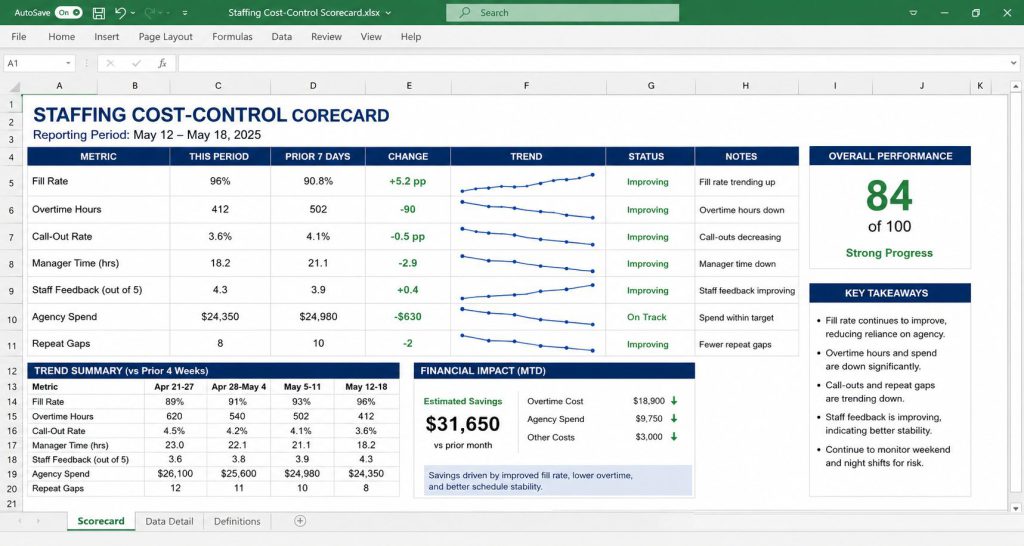
You can’t control agency staffing costs if you only track agency spend.
Spending definitely matters, but spending alone doesn’t tell you whether using the agency is helping or hurting.
You need to measure agency usage against staffing outcomes.
Fill Rate
Fill rate tells you whether agency support is improving coverage.
Track:
- Overall fill rate
- Fill rate by shift type
- Fill rate by role
- Fill rate by unit
- Fill rate before and after agency use
If agency spend increases but fill rate improves on hard-to-cover shifts, that may be a good tradeoff.
If agency spending increases and the fill rate doesn’t improve, the usage plan needs review.
Overtime Avoided
Agency support should also be compared against overtime.
Track:
- Overtime hours before agency use
- Overtime hours after agency use
- Overtime by unit
- Overtime by role
- Overtime by employee
If agency is being used correctly, it should reduce pressure somewhere.
That doesn’t always mean total overtime disappears. But it should reduce repeated overtime in areas that an agency was meant to support.
Call-Outs
Call-outs are an important signal.
If agency support reduces repeated overtime and stabilizes coverage, call-outs might improve over time.
Track:
- Call-outs by unit
- Call-outs after overtime-heavy periods
- Call-outs on hard-to-fill shifts
- Call-outs before and after agency support
Don’t expect one agency shift to fix call-outs. Look for a trend of improvement.
Manager Time
Manager time is one of the easiest costs to ignore.
But if agency support reduces hours spent chasing coverage, that matters.
Track:
- Time spent filling open shifts
- Number of coverage texts/calls
- Number of escalations
- Time spent reshuffling schedules
- Time spent approving incentives
A staffing solution that reduces manager scramble has operational value beyond the hourly rate.
Staff Feedback
Numbers matter, and so does what your team is telling you.
Ask:
- Are we relying less on the same people?
- Do shifts feel more stable?
- Are weekend and night gaps improving?
- Is overtime more manageable?
- Are staff still feeling pressured to pick up?
- Do managers feel they have better options?
Staff feedback helps identify whether agency support is actually relieving pressure.
Agency Spend
Yes, track agency spend.
But break it down.
Track spend by:
- Unit
- Role
- Shift type
- Reason
- Approval owner
- Recurring vs. one-time need
This is how agency spend becomes manageable.
A single total spend number isn’t enough. You need to know where the spending went, so you can tie it to outcomes.
Reassess Every 30/60/90 Days
Controlled agency use needs a review cadence.
The 30/60/90-day structure keeps facilities from overreacting or drifting.
30-Day Review: Is the Support Solving the Immediate Problem?
At 30 days, focus on the short-term issue.
Ask:
- Did agency help fill the targeted shifts?
- Did overtime decrease in the target area?
- Did manager’s scramble improve?
- Were there quality or reliability concerns?
- Did the approval process work?
- Were the shifts appropriate for agency use?
At this stage, don’t overcorrect too fast. You’re checking whether the support is doing what it was supposed to do.
60-Day Review: Are We Seeing Pattern Improvement?
At 60 days, look for trends.
Ask:
- Are repeat gaps decreasing?
- Are call-outs stabilizing?
- Are internal pickup rates improving?
- Are fewer staff being asked repeatedly?
- Is agency spend concentrated in the right areas?
- Are managers spending less time filling shifts?
This is where you decide whether the plan needs adjustment.
Maybe agency is working, but only on certain shifts.
Maybe the approval path is too slow.
Maybe your facility is using agency for the wrong roles.
Adjust the rules.
90-Day Review: Keep, Adjust, or Exit
At 90 days, make a decision.
For each agency use case, choose one:
- Keep
- Reduce
- Expand
- Replace
- Exit
Use the data.
If agency support reduced overtime, stabilized coverage, and protected staff, it may be worth continuing in a controlled way.
If agency support didn’t improve outcomes, revise the plan.
If the original gap no longer exists, exit the support.
This is how you can prevent agency dependency.
Build an Agency Cost Control Scorecard
Use a simple scorecard monthly.
| Metric | Why It Matters | Direction You Want |
| Fill rate | Shows coverage reliability | Up |
| Overtime hours | Shows pressure on internal staff | Down |
| Call-outs | Shows possible fatigue/stability issues | Down |
| Manager time | Shows operational drag | Down |
| Staff feedback | Shows whether pressure is easing | Improving |
| Agency spend | Shows budget impact | Controlled |
| Repeat gaps | Shows whether the issue is improving | Down |
Your scorecard should answer one question:
Is agency support reducing pressure in a measurable way?
If yes, you have controlled agency usage.
If no, you have agency spending without a staffing strategy.
Choose a Staffing Partner That Supports Control
Controlling agency costs is easier when the staffing partner gives facilities visibility.
Cascade Health Services’ W-2 Workforce Marketplace helps facilities request staff, track shift status, manage schedules, view reporting, and maintain credential and compliance visibility. Cascade also handles HR, taxes, insurance, work comp, and related employer responsibilities for its W-2 workforce.
That matters because cost control is not just about rate.
It is also about:
- Visibility
- Reliability
- Reporting
- Compliance
- Speed
- Fewer administrative headaches
- Clearer staffing decisions
A lower-friction model helps agency support stay intentional instead of chaotic.
Download the Agency Staffing Decision Toolkit
The goal isn’t to have no agency.
The goal is controlled agency.
The Agency Staffing Decision Toolkit helps facility leaders decide when agency support makes sense, how to set guardrails, and how to review outcomes without losing control of the budget.
Inside, you’ll get:
- A decision score
- A cost comparison framework
- Agency-use guardrails
- Leadership-ready talking points
- A 30/60/90-day review structure
Download the Agency Staffing Decision Toolkit to control agency staffing costs without running short.
FAQs About Controlling Agency Staffing Costs
How can facilities control agency staffing costs?
Facilities can control agency staffing costs by setting usage rules, defining approval paths, prioritizing high-pressure shifts, tracking outcomes monthly, and reassessing agency use every 30, 60, and 90 days.
What shifts should agency staffing be used for?
Agency staffing is often most useful for recurring pressure points like nights, weekends, holidays, hard-to-fill roles, and last-minute call-outs when internal coverage would create overtime or burnout risk.
How do you avoid agency dependency?
Avoid agency dependency by setting usage thresholds, requiring review dates, tracking success metrics, and adjusting or ending agency use when the original staffing problem improves.
What metrics should facilities track for agency staffing?
Facilities should track fill rate, overtime avoided, call-outs, manager time, staff feedback, agency spend, and repeat open shifts.
Is cutting agency use always the best way to reduce costs?
No. Cutting agency use without solving the underlying coverage problem can move costs into overtime, call-outs, manager time, burnout, and turnover risk.
