
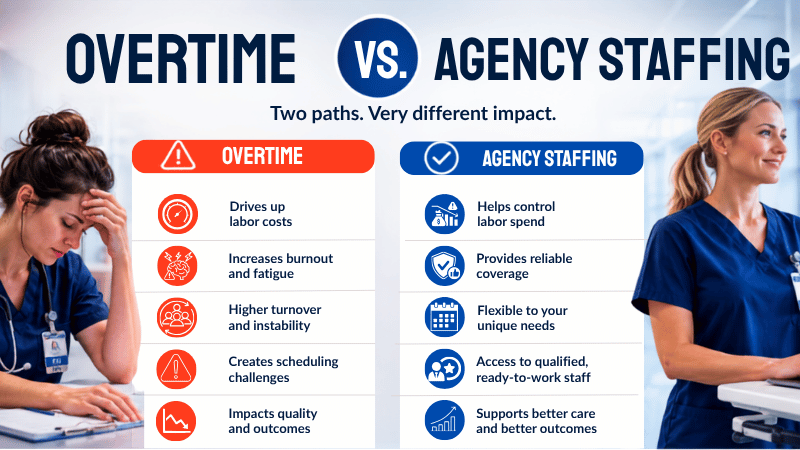
Agency staffing can cost less when repeated overtime creates burnout, call-outs, manager time, turnover risk, and coverage instability. The real comparison is not agency rate vs. internal hourly rate. It’s total staffing cost vs. total staffing cost.
On paper, overtime can look like the cheaper option. You already know the employee, they already work there, and the rate’s familiar.
Agency staffing feels different, the rates are unfamiliar, and the invoice gets attention.
But visible doesn’t always mean more expensive. On the other hand, familiar doesn’t mean cheaper.
If overtime is solving a one-time gap, it’s probably the right choice. But if overtime is covering the same shifts, the same roles, or the same call-outs week after week, the math changes.
At that point, overtime isn’t just a labor cost. It’s a clear signal that your staffing model is under pressure.
Why Overtime Looks Cheaper Than It Is
Overtime feels cheaper because it starts with an internal rate. Your leadership team already knows what their staff earns. They already have a payroll system in place that handles that. They might view overtime as a normal part of healthcare operations.
And sometimes it is. Healthcare is fast-paced; your schedule can feel great one second, and you’re stretched thin the next. But overtime becomes misleading when leaders only compare hourly rates.
For example:
Internal overtime rate vs. agency rate is not the full comparison. Agencies offer a lot more than filling a shift if you look at what they do for your team.
The fuller comparison is:
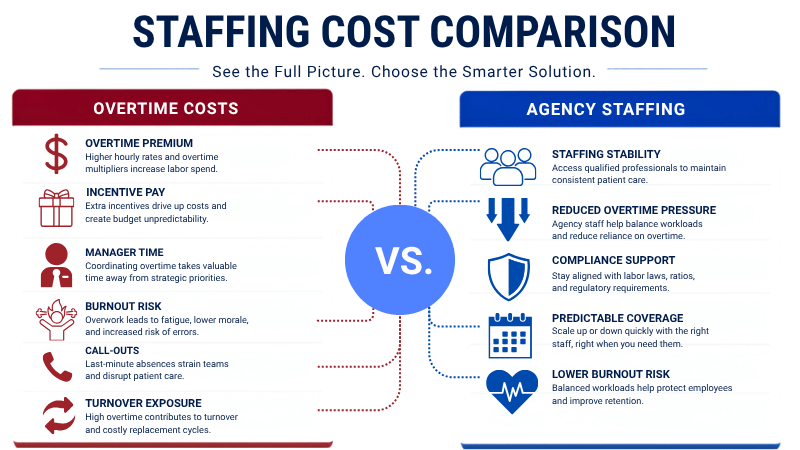
Cost = Internal overtime + incentives + manager time + call-out risk + burnout risk + turnover exposure
vs.
Cost = Agency bill rate – any reduced internal pressure – better coverage stability – lower burnout risk
That is a very different equation.
Internal rates feel familiar
Internal overtime is easier to accept because it happens inside the existing system. You don’t have to deal with new vendors, approval paths, or new invoices.
But familiar costs can add up. If overtime keeps climbing it may be hiding a deeper staffing issue.
Agency invoices feel bigger
Agency costs are more visible because they are concentrated.
That makes them easier to criticize.
But that visibility can also be useful. A visible cost can be reviewed, managed, capped, and tied to specific use cases.
Hidden costs are harder.
They show up across payroll, turnover, call-outs, manager workload, and morale.
Hidden costs are scattered
This is where facilities undercount overtime.
The overtime line item may show the premium pay. But it may not show:
- The scheduler’s time filling the shift
- The DON’s time escalating the issue
- The extra incentive needed to get someone to say yes
- The call-out that happens after repeated overtime
- The reliable employee who stops picking up
- The resignation that comes three months later
In a recent article published by OSHA, they showed that long work hours and irregular or extended shifts can contribute to fatigue, stress, lack of concentration, illness, and increased injury risk. OSHA also notes that demanding schedules are common among healthcare providers. So, you’re not alone in this.
It matters because repeated overtime is not just a budget issue. It can become a workforce risk.
1. Overtime Premium
Start with the direct cost.
Overtime usually means paying time-and-a-half or another premium rate depending on policy, state law, role, union agreement, and schedule rules.
Track:
- Total overtime hours
- Overtime by role
- Overtime by unit
- Overtime by shift type
- Overtime by employee
- Overtime trend over time
The trend matters more than one pay period.
A single overtime spike may be manageable.
Recurring overtime means the facility is paying extra to cover a predictable gap.
2. Incentive Pay
Overtime is not always the only extra cost.
A lot of facilities use:
- Bonus shifts
- Crisis rates
- Last-minute pickup incentives
- Weekend incentives
- Holiday premiums
- Shift differentials
These incentives can help in the moment, but they can also become part of the expectation.
If your staff only pick up certain shifts when incentives are attached, that is important data. It means the shift is not just open – it’s hard to staff.
3. Manager Time
Your management team’s time is one of the most overlooked costs in the comparison.
When overtime is used, someone usually spends time trying to fill the shift first.
That might include:
- Sending coverage texts
- Calling staff
- Reviewing availability
- Reshuffling assignments
- Approving incentives
- Escalating to leadership
- Updating the schedule
- Managing staff frustration
Here’s a simple way to estimate the cost of manager time:
Manager time cost = hours spent filling the shift × manager hourly cost
Even if you don’t calculate the exact number, track the pattern.
If managers are spending hours every week chasing the same coverage gaps, overtime is not the only cost.
The staffing process itself is costing you.
4. Call-Out Risk
Repeated overtime can create the next staffing gap.
That’s the cycle most facilities miss.
A shift opens.
Someone works overtime.
The team gets through the day.
The same people keep stretching.
Fatigue builds.
Call-outs increase.
Your best team members quit.
Now overtime isn’t just solving the problem. It’s feeding the problem.
Track call-outs against overtime patterns:
- Do call-outs rise after overtime-heavy weeks?
- Are call-outs higher in units with repeated overtime?
- Are the same employees working extra and then calling out later?
- Do certain shifts create both overtime and call-outs?
This turns staffing from reactive to measurable.
5. Turnover Exposure
Turnover is where the overtime vs. agency comparison gets serious.
If repeated overtime contributes to burnout or resignations, the cost of “saving money” can actually be a lot higher.
Becker’s Hospital Review, summarizing the 2026 NSI National Health Care Retention & RN Staffing Report, reported that the average cost of turnover for one staff RN was $60,090 in 2025, with hospitals losing an average of about $5.19 million per year to RN turnover.
A single resignation can erase a lot of perceived overtime savings.
Before you think I’m fear-mongering, I’m not saying the occasional overtime shift causes turnover. The keyword here is repeated over time.
Repeated overtime needs to be treated as a retention killer, especially when it’s falling on the same good employees.
6. Coverage Reliability
The cheapest option isn’t always the best option if it’s unreliable.
Ask:
- Did the shift get filled?
- How late was it filled?
- How many people had to be contacted?
- Did the same employee cover again?
- Was the unit still strained?
- Did managers have a backup plan?
- Did the solution reduce future pressure?
Reliable coverage has value.
A staffing strategy that reduces last-minute chaos may be worth more than a cheaper workaround that keeps failing.
A Simple Overtime vs. Agency Cost Framework
Use this framework when comparing options.
| Cost Factor | Overtime | Agency Staffing |
| Direct rate | Usually familiar | More visible |
| Approval friction | Often lower | May require review |
| Manager time | Can be high if coverage is chased manually | Can be lower if request process is clear |
| Burnout risk | Higher if repeated or concentrated | Lower if used to relieve pressure |
| Call-out risk | Can increase after heavy stretches | Can reduce strain on core staff |
| Turnover exposure | Higher if same staff are overused | Lower if core staff are protected |
| Budget visibility | Scattered across payroll and operations | Clearer line item |
| Best use case | One-time or voluntary extra shift | Recurring gaps or hard-to-fill shifts |
The point isn’t that agency is always cheaper.
It’s not. (Even if I really wish it were).
The point is that overtime is not automatically cheaper either.
When Overtime Is the Better Option
Overtime can be the right choice when the gap is limited, voluntary, and unlikely to create additional strain.
A One-Time Gap
If one employee calls out unexpectedly and another employee wants the extra hours, overtime might be the simplest solution.
That is especially true when:
- The shift is not part of a recurring pattern
- The employee is not already overextended
- The unit is otherwise stable
- The manager does not need to spend hours finding coverage
In this case, overtime is doing what it’s supposed to do: provide short-term flexibility.
The Employee Wants Extra Hours
Some nurses and CNAs want overtime.
They may be saving for something, trying to increase income, or simply prefer extra shifts.
That’s fine.
The issue is not voluntary overtime.
The issue is dependence.
If the same person wants occasional extra hours, that can work. If the facility needs that same person to work extra every week for the schedule to function, that’s not the same.
Some facilities use an overtime request sheet, so they can reach out to employees looking for more hours before bothering the people who don’t want it.
The Need Is Truly Short-Term
Overtime might also make sense for short-term openings, like:
- A brief census spike
- A couple of days of PTO overlap
- A temporary illness cluster
- A short transition between hires
- A one-off holiday coverage issue
The key question:
Will this gap go away soon?
If yes, overtime may be reasonable.
If not, the facility needs a more sustainable coverage plan.
When Agency Staffing Makes More Sense
Agency staffing makes more sense when overtime stops being occasional and starts becoming structural.
Repeating Gaps
If the same shifts are open every week, overtime is probably not solving the issue.
It is covering it temporarily.
Repeating gaps may include:
- Weekend shifts
- Overnight shifts
- Holiday coverage
- Specific roles
- Specific units
- Known call-out patterns
These are the places where agency or PRN support can act as a controlled pressure valve.
Hard-to-Fill Shifts
Some shifts are harder to fill than others. You might need someone with a certain specialty background that no one else has.
It doesn’t always mean that your team isn’t willing to help. It might mean the shift is genuinely undesirable, poorly timed, more demanding, or consistently understaffed.
Hard-to-fill shifts are good candidates for outside support because relying on internal staff might require repeated incentives or overtime.
The Same Employees Are Being Overused
If the same employees are always picking up, you’re probably creating turnover risk.
That’s where agency staffing can be super productive.
Not because outside support is always cheaper by the hour, but because it can reduce pressure on the employees you need to keep the most.
Call-Outs Are Rising
Rising call-outs can be a sign that the team is stretched.
If call-outs increase after overtime-heavy stretches, the facility shouldn’t keep solving the problem with more overtime.
That cycle can get expensive fast.
Managers Are Spending Too Much Time Chasing Coverage
If leaders are constantly patching the schedule, agency support may reduce operational drag.
This is especially true when your staffing partner gives managers a clearer request process, visibility into shift status, and more predictable support.
Cascade Health Services’ W-2 Workforce Marketplace helps facilities access pre-vetted W-2 nurses, CNAs, allied health professionals, and more. Facilities can request staff, track shift status, manage schedules, view reporting, and maintain credential and compliance visibility, while Cascade handles HR, taxes, insurance, work comp, and related employer responsibilities.
That matters because the comparison is not only rate vs. rate – it also includes workload, risk, and control.
How to Decide: Overtime or Agency?
Use this decision framework.

Use overtime when:
- The gap is one-time
- The employee wants the hours
- The team is not already stretched
- The shift does not create a repeat pattern
- Manager time is minimal
- Coverage remains stable
Consider agency staffing when:
- The same shift keeps opening
- Overtime is rising
- Incentives are becoming routine
- The same staff are covering repeatedly
- Call-outs are increasing
- Managers are constantly chasing coverage
- The gap is predictable
- Internal pickup is declining
Review the decision monthly
Don’t make the overtime vs. agency decision once and forget it. You need to review it monthly until you have the balance figured out. Every facility is different, but taking the time to get your staffing strategy right can save you a fortune in recruiting costs.
Review:
- Overtime hours
- Agency usage
- Fill rate
- Call-outs
- Manager time
- Employee pickup rates
- Staff feedback
- Turnover risk indicators
If overtime goes down but shifts run short, the problems are not solved.
If agency spend goes up but overtime, call-outs, and manager time go down, the total cost is probably improving.
That’s why a full comparison matters. On paper, agencies look more expensive, but functionally, they’ll save you money.
The Better Question: What Is the Total Cost of Coverage?
You can’t only ask
“Which option has the lower hourly rate?”
Ask:
“Which option gives us stable coverage at the lowest total cost and the lowest workforce risk?”
That question alone can change the conversation. Because “cheaper” isn’t actually cheaper if it creates more call-outs, more manager time, more burnout, more turnover, and more schedule instability.
Overtime has its place.
Agency staffing has a place.
The smartest move is knowing when to use each one. Then you’ll really be able to reduce overtime without losing coverage.
Download the Agency Staffing Decision Toolkit
Before the next budget conversation, compare the real cost.
The Agency Staffing Decision Toolkit helps facility leaders evaluate agency staffing against overtime, burnout, manager time, call-outs, and turnover risk.
Inside, you’ll get:
- A decision score
- A cost comparison framework
- Agency-use guardrails
- Leadership-ready talking points
- A 30/60/90-day review structure
Download the Agency Staffing Decision Toolkit to compare costs before the next staffing decision becomes another schedule scramble.
FAQs About Overtime vs. Agency Staffing
Is agency staffing cheaper than overtime?
Sometimes. Agency staffing can be cheaper when repeated overtime creates hidden costs such as manager time, burnout risk, call-outs, and turnover exposure.
When is overtime better than agency staffing?
Overtime is usually better for one-time gaps, short-term needs, or voluntary extra shifts when your team isn’t already overextended.
When should facilities use agency staffing instead of overtime?
Facilities should consider agency staffing when gaps repeat, overtime becomes routine, incentives are increasing, call-outs are rising, or the same employees are repeatedly covering extra shifts.
Why does overtime cost more than it looks like?
Overtime can cost more than it looks like because the payroll premium is only one part of the cost. Manager time, incentives, fatigue, call-outs, and turnover risk can all add to the true cost.
How can facilities compare agency staffing and overtime fairly?
Facilities should compare total cost, not just the hourly rate. Include overtime premium, incentives, manager time, call-out impact, turnover exposure, and coverage reliability.
