
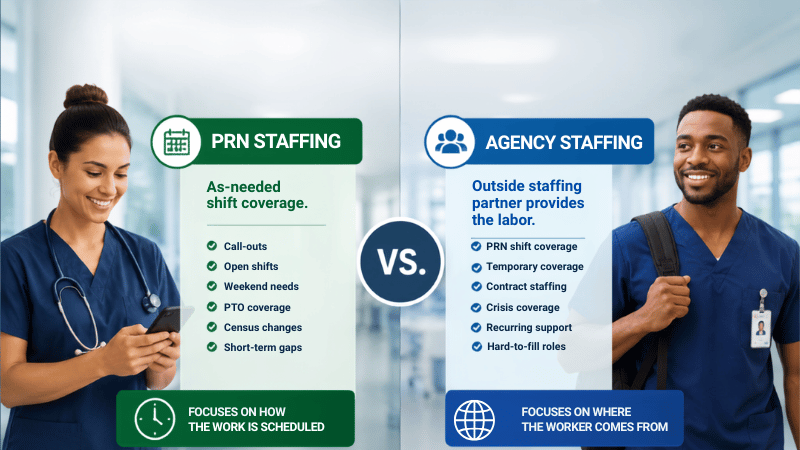
PRN is as-needed shift coverage. Agency staffing describes the source of outside labor. Your facility might use agency support for PRN shifts, contract coverage, or recurring schedule gaps.
These terms get mixed up all the time, and depending on your role, they usually mean the same thing, but other times they won’t. That matters because the right staffing model depends on the problem you’re trying to solve.
- Are you filling one open shift?
- Covering recurring weekends?
- Reducing overtime?
- Protecting core staff?
- Managing compliance risk?
- Trying to avoid last-minute chaos?
PRN and agency staffing can help, but they’re not the same, and they won’t solve your problems in the same way.
What PRN Staffing Means
PRN means “as needed”.
In healthcare staffing, PRN staffing usually refers to flexible shift coverage that facilities use when demand changes, schedules shift, or facilities need extra help without adding permanent full-time roles.
PRN coverage is usually used for:
- Call-outs
- Open shifts
- Census changes
- PTO coverage
- Weekend needs
- Holiday coverage
- Short-term staffing gaps
- Hard-to-fill shifts
PRN is about how the work is scheduled.
It’s flexible, shift-based, and you can use it when your facility needs coverage, but not necessarily a permanent hire. A lot of facility leaders use PRN staffing when they’re experiencing a census fluctuation that they expect will go away sooner rather than later.
PRN can be internal or external
Okay, this is where things get a little confusing.
Your facility might use internal PRN employees as part of its staffing strategy. They are workers who are part of your facility’s workforce, but they only pick up shifts as needed.
A lot of facilities also use an outside staffing partner to access PRN coverage. So “PRN” doesn’t automatically mean agency.
It just means the coverage happens on an as-needed basis.

What Agency Staffing Means
Agency staffing refers to using an outside staffing partner to provide labor.
That support is usually:
- PRN shift coverage
- Temporary coverage
- Contract staffing
- Crisis coverage
- Recurring support
- Hard-to-fill role coverage
Agency staffing is about where labor comes from.
It goes without saying that filling every opening can be impossible for facilities. If you have an internal PRN team, you’ll most likely only rely on an agency if no one is available to pick up. If an internal PRN team isn’t in the picture, your facility will probably rely on agencies more often than not.
Agency models vary
No two agencies are the same. Here are some of the key differences:
- Some agencies focus on long-term contracts.
- Some focus on per diem or PRN shifts.
- Some operate more like gig platforms.
- Some use W-2 employees.
- Some rely on 1099 independent contractors.
- Some provide strong compliance visibility.
- Some leave more administrative work on the facility.
That means the question should not be:
“Should we use agency?”
The better question is:
“What kind of agency model gives us the right coverage, control, and risk protection?”
Why PRN and Agency Get Confused
PRN and agency staffing get confused a lot because they have overlapping practices.
Your facility might call an agency because it needs PRN coverage. Your agency partner provides clinicians to cover any openings.
A PRN nurse might work through a staffing platform.
Your facility might use “agency” as shorthand for any outside worker.
The terms get blurry because healthcare staffing is messy. But the distinction between the two still matters.
PRN describes the shift type
PRN answers:
How is the work being used?
Usually:
- As needed
- Shift by shift
- Flexible
- Based on demand
Agency describes the source
Agency answers:
Where is the worker coming from?
Usually:
- Outside staffing partner
- External workforce
- Marketplace or agency model
- Temporary or recurring support
A facility can use both at once
Some facilities use an agency for PRN shifts that their internal PRN teams aren’t filling. That’s one of the things that makes explaining the difference between the two so hard. They accomplish the same goals, but the source of the PRN clinicians is different.
Why the Employment Model Matters
It’s pretty common to assume all outside staffing models carry the same amount of risk. That couldn’t be further from the truth.
The employment model matters because it affects compliance, reliability, administrative burden, and control.
W-2 vs. 1099
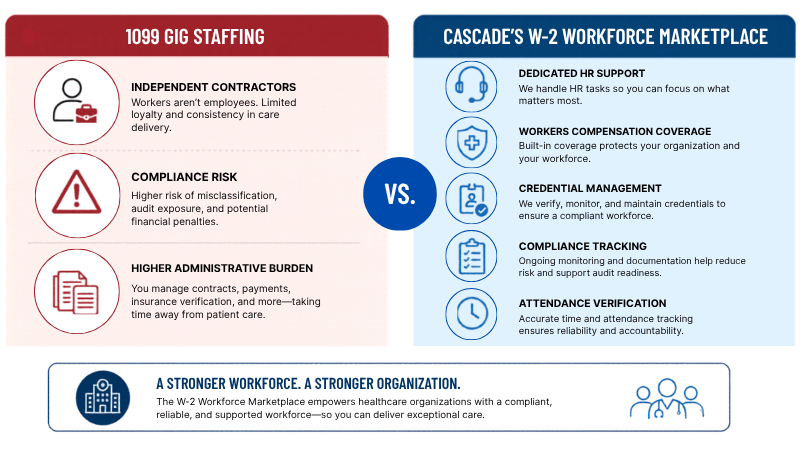
A W-2 staffing model means clinicians are employees of the staffing company.
A 1099 model means workers are independent contractors.
That difference can affect:
- Taxes
- Insurance
- Workers’ compensation
- HR management
- Benefits
- Worker classification risk
- Compliance processes
- Performance accountability
Cascade Health Services positions its model as a W-2 Workforce Marketplace, not a 1099 gig model. Cascade employs clinicians as W-2 staff and handles taxes, insurance, benefits, compliance, HR issues, and workers’ compensation responsibilities for facilities using its workforce.
That is a major distinction for facility leaders who want flexibility without taking on unnecessary administrative burden.
You can learn more about 1099 vs. W-2 agencies in our blog.
Compliance visibility
Healthcare staffing isn’t just about filling the shift.
Facilities need to know workers are qualified, credentialed, and ready.
That includes:
- Licenses
- Certifications
- Credential expirations
- Role qualifications
- Compliance documentation
- Survey readiness
Cascade’s facility-side marketplace includes credential and compliance visibility, scheduling tools, reporting, and support for facilities that need qualified clinicians without managing every back-office detail themselves.
For facilities, that visibility can matter as much as speed.
Fast staffing is useful.
Fast staffing without compliance control is risky.
Reliability
Reliability is another reason the model matters.
A facility needs to know:
- Will the worker show up?
- Are credentials current?
- Is the shift status visible?
- Can attendance be verified?
- Is there support if something changes?
- Who handles issues when they happen?
Cascade’s W-2 Workforce Marketplace includes real-time shift status, GPS-verified clock-in/out, reporting, and 24/7 human support.
That gives facilities more control than a purely transactional staffing process.
Employer burden
Agency staffing can reduce facility burden when the partner handles employment responsibilities.
That may include:
- Payroll
- Taxes
- Insurance
- HR issues
- Workers’ compensation
- Compliance tracking
- Credential management
The value is not only “we got a shift filled.”
The value is:
“We got coverage without taking on all the employment overhead ourselves.” After all, agencies should be saving your management team time, not adding to it.
Risk management
PRN and agency staffing shouldn’t create more risk than they solve.
When you’re choosing a model, you should ask:
- Who employs the worker?
- Who handles taxes and insurance?
- Who tracks credentials?
- Who manages performance concerns?
- Who verifies attendance?
- Who supports the facility after hours?
- What happens if a shift changes or cancels?
The right model should give facilities flexibility and control. Not flexibility with a pile of extra risk attached.
Which Model Should Facilities Use?
The right model depends on the staffing problem. Don’t start with the label.
Start with the gap.
Use internal PRN when the need is occasional and manageable
Internal PRN can work well when:
- The gap is occasional
- Existing staff want extra shifts
- The role is easy to cover
- The unit is stable
- Overtime isn’t climbing
- Staff aren’t overextended
Internal PRN is often the simplest option when demand is limited and the internal pool is healthy. However, starting your own PRN team is extremely time-consuming; you’ll need someone to manage them and someone to keep them engaged. If you don’t already have an internal float team, you’ll probably need to partner with an agency while you figure out all of the ins and outs.
Use outside PRN support when internal pickup isn’t enough
Outside PRN support may make sense when:
- Internal pickup is declining
- Overtime is becoming routine
- The same staff are covering repeatedly
- Weekends or nights are hard to fill
- Call-outs are increasing
- Managers are spending too much time chasing coverage
This is where a staffing partner can help protect the core team.
Use agency support for recurring or hard-to-fill gaps
Agency support becomes more useful when the issue isn’t random.
Examples:
- Recurring weekend gaps
- Repeated overnight coverage problems
- Persistent CNA, LPN, RN, or allied role shortages
- PTO-heavy periods
- Seasonal demand changes
- Call-out patterns
- Coverage gaps tied to turnover
If the same gap keeps showing up, your facility needs more than another last-minute text.
It needs a coverage strategy.
Prioritize W-2 support when compliance and control matter
Facilities that are concerned about compliance, worker classification, credential tracking, and accountability should pay close attention to the employment model.
A W-2 workforce model can give your facility staffing support while reducing some of the administrative and classification concerns associated with 1099-style staffing. Cascade uses a W-2 model, pre-vetted clinicians, compliance visibility, and human support that you can’t get with 1099 gig apps.
A Simple Decision Framework
Use this framework when deciding between PRN, agency, or both.
| Staffing Need | Best Fit | Why |
| One-time open shift | Internal PRN or overtime | Simple, short-term need |
| Recurring weekend gaps | Outside PRN/agency support | Pattern needs a plan |
| Hard-to-fill role | Agency staffing partner | Expands access to qualified workers |
| High overtime in one unit | PRN or agency support | Reduces pressure on core staff |
| Compliance-sensitive coverage | W-2 staffing model | Better visibility and employment structure |
| Manager time is too high | Staffing partner | Reduces scramble and administrative load |
| Internal staff are overused | External PRN support | Protects your core team from burnout |
PRN and agency staffing are connected, but they are not interchangeable.
PRN is the type of coverage.
Agency is the source of support.
The employment model determines how much risk, visibility, and control the facility has.
For facility leaders, the real question isn’t:
“Do we need PRN or agency?”
The better question is:
“What staffing model gives us the coverage we need without overloading our team or increasing risk?”
That’s the decision that matters.
Download the Agency Staffing Decision Toolkit
Choosing the right staffing model should not be guesswork.
The Agency Staffing Decision Toolkit helps facility leaders compare staffing options, understand when outside support makes sense, and set guardrails before costs or coverage gaps get out of control.
Inside, you’ll get:
- A decision score
- A cost comparison framework
- Agency-use guardrails
- Leadership-ready talking points
- A 30/60/90-day review structure
Download the Agency Staffing Decision Toolkit to decide when PRN or agency support makes sense for your facility.
FAQs About PRN vs. Agency Staffing
Is PRN the same as agency staffing?
No. PRN refers to as-needed shift coverage. Agency staffing refers to using an outside staffing partner. A facility can use an agency to fill PRN shifts, but the terms don’t mean the same thing.
Can agency staff work PRN shifts?
Yes. Agency staff may be used for PRN shifts, temporary coverage, recurring gaps, or contract roles, depending on the staffing partner and facility needs.
Is internal PRN better than agency staffing?
Internal PRN may be better for occasional, manageable gaps. Agency staffing may be better when gaps repeat, internal pickup declines, overtime rises, or the facility needs more support than its internal pool can provide.
Why does W-2 staffing matter?
W-2 staffing matters because the staffing partner employs the worker and may handle taxes, insurance, HR, workers’ compensation, and compliance responsibilities. This can reduce administrative burden for facilities.
When should a facility use outside PRN support?
A facility should use outside PRN support when internal staff is overused, overtime is climbing, call-outs are rising, weekend or night shifts are hard to fill, or managers are spending too much time chasing coverage.
